Somewhere this month, a program officer will ask a founder "who is your fiscal agent?" and the founder will answer with the name of her fiscal sponsor. Most days the slip costs nothing. But the two terms describe opposite legal relationships, and the difference between them decides a question your donors care about a great deal: whether their gifts are tax deductible.
If fiscal sponsorship is new to you, start with our explainer on how fiscal sponsorship works. This piece is about the boundary line, because funders, agreements, and even some state forms still use the two labels interchangeably, and the IRS does not.
A Fiscal Sponsor Legally Owns the Money
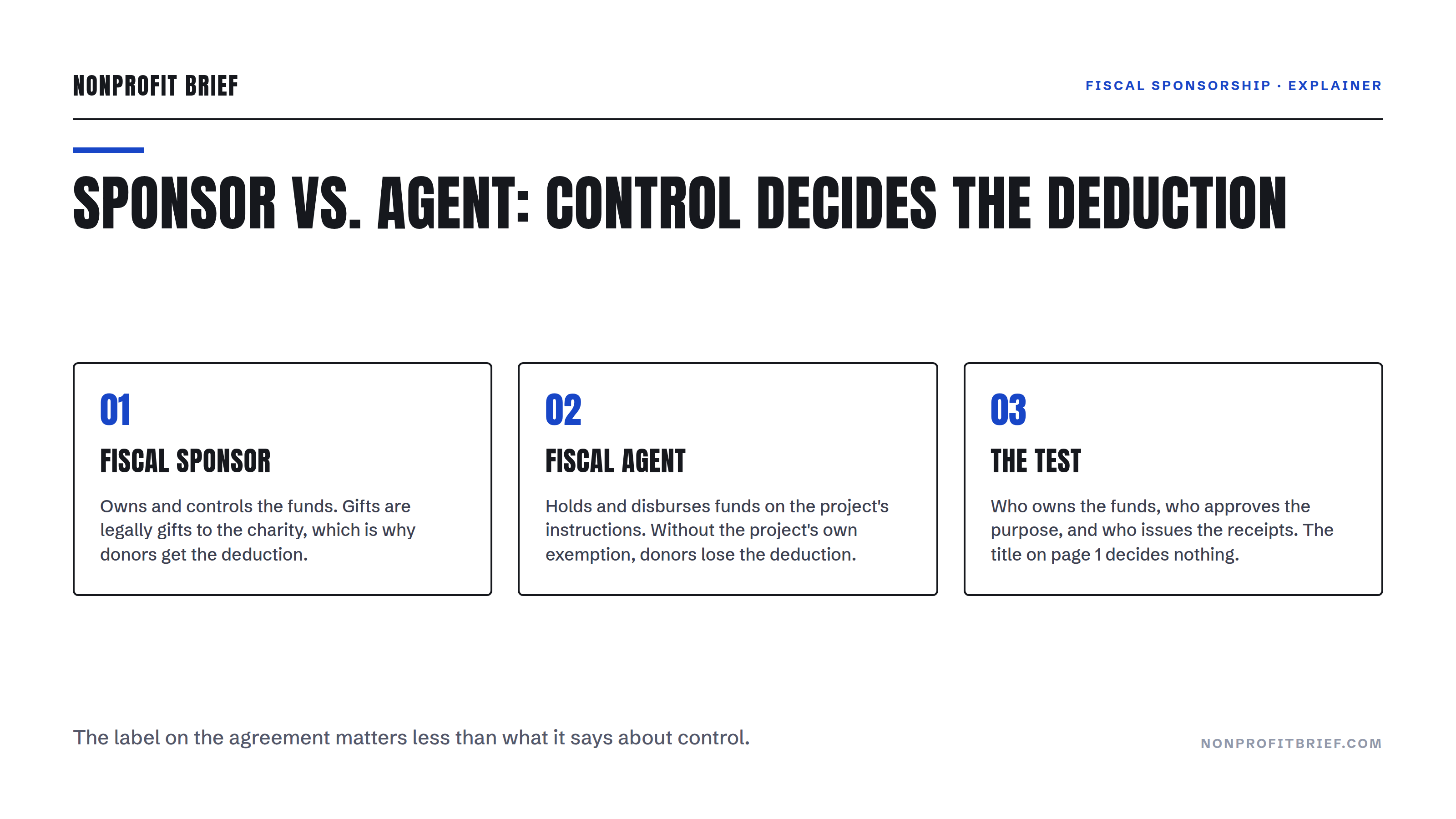
In a fiscal sponsorship, donors give to the sponsor, a 501(c)(3) public charity, and the sponsor spends or regrants the money on your project's work. The gift is deductible because it is legally a gift to the sponsor. That only holds if the sponsor genuinely controls the funds. The IRS standard, set out in a line of rulings on charities that regrant money, is that the charity must have full control of the donated funds and discretion as to their use, so the money carries out the charity's own exempt purposes. That is why a real sponsor's board approves your project's purpose before fundraising starts, why the sponsor can refuse an expense that falls outside that purpose, and why the sponsor, not you, issues the donation receipts your donors file with their taxes.
Control is not paperwork theater. It is what makes the arrangement work in both dominant structures, which we compared in Model A versus Model C. In Model A your project is inside the sponsor and the funds were never anyone else's. In Model C you are separate and the sponsor makes preapproved grants to you, keeping that same discretion over every dollar in between: it releases funds for the approved project as the work needs them, and it collects the reports and records that show the money did charitable work. And even under a genuine sponsorship, a gift the donor legally earmarks for one recipient, or a solicitation promising funds will go to one, can cost that donor the deduction. The discretion has to be real in the fundraising ask, not just the agreement.
A Fiscal Agent Works for You, and That Is the Problem
Agent is a term from agency law, and it means the opposite of sponsor. An agent acts on behalf of a principal and under the principal's direction. If a charity is your fiscal agent, you are the principal: the money it holds is your money, and it must do what you tell it to do with the funds. As Gregory Colvin's Fiscal Sponsorship: 6 Ways to Do It Right, the field's standard text, now in a third edition with Stephanie Petit, puts it in a synopsis, calling the charity an agent implies the project controls the relationship, when tax law requires the reverse.
Here is where deductibility breaks. If your project is not itself a 501(c)(3), a donation routed through a charity that is merely your agent is, in the IRS's eyes, a gift to you, and unless the real recipient is itself qualified to receive deductible gifts under the tax code, there is no deduction. The anchor is Revenue Ruling 63-252, which held that when contributions are committed in advance to a particular recipient and merely pass through the charity on the way, the charity is only nominally the donee; the real donee is the ultimate recipient. The ruling arose from charities passing money to foreign organizations, but the principle it stands for, that earmarked pass-through gifts belong to whoever really controls them, is the same one the IRS applies to a charity fronting for a domestic project. A charity that operates as a conduit is not just failing its donors; it is putting its own exemption at risk, since it is no longer spending money on its own exempt purposes.
The vocabulary itself is a fossil. Fiscal agent was the field's common term for decades, until Colvin's 1993 book argued the label mislabeled the relationship and pushed the field to fiscal sponsorship. The old term still circulates, which is why the label on your agreement matters less than what it says about control.
When a Fiscal Agent Is the Right Tool
A true agency arrangement is not a defect. It is the correct structure when the project is already a 501(c)(3) in its own right. A small charity might hire a larger organization as its fiscal agent to hold funds, run bookkeeping, or process payments while it builds capacity. Deductibility is not in question there, because donors are giving to a charity either way; the agent is just administration. Government programs add a wrinkle: some agencies use fiscal agent loosely for whichever entity receives and disburses program funds, so a grant application may hand you the word even when the relationship underneath is a sponsorship.
How to Tell Which One You Actually Signed
Read the agreement for substance, not the title on page 1. Whose money is it once a donor gives? If the charity owns the funds and can decline expenditures that fall outside the approved charitable purpose, you have a sponsor. If the document says funds are held for the project, or the charity must disburse on your instruction, you have an agent, whatever it calls itself. Look for the discretion and control language, check who issues donor receipts, check who approves a change in the project's purpose, and check what reports and records you owe the sponsor, because a sponsor that never asks for an accounting is not exercising the control the deduction depends on. If your project is not exempt and the answers point to agency, raise it before the next fundraising push, not after. Whether a specific arrangement holds up turns on your facts and the document you signed, and this is not legal advice for your situation; a sponsor or counsel can usually confirm the structure in one conversation. And because the relationship is defined by the exit as much as the entrance, know what happens to the funds if you leave before you need to.
The takeaway
A fiscal sponsor controls the money, which is precisely what makes your donors' gifts deductible. A fiscal agent takes direction from you, which is precisely what makes gifts routed through one non-deductible when your project is not itself qualified to receive them. Use fiscal agency when the project already has its own exemption, use fiscal sponsorship when it does not, and if a funder or a form hands you the wrong word, take it as a prompt to check what your own agreement really says.