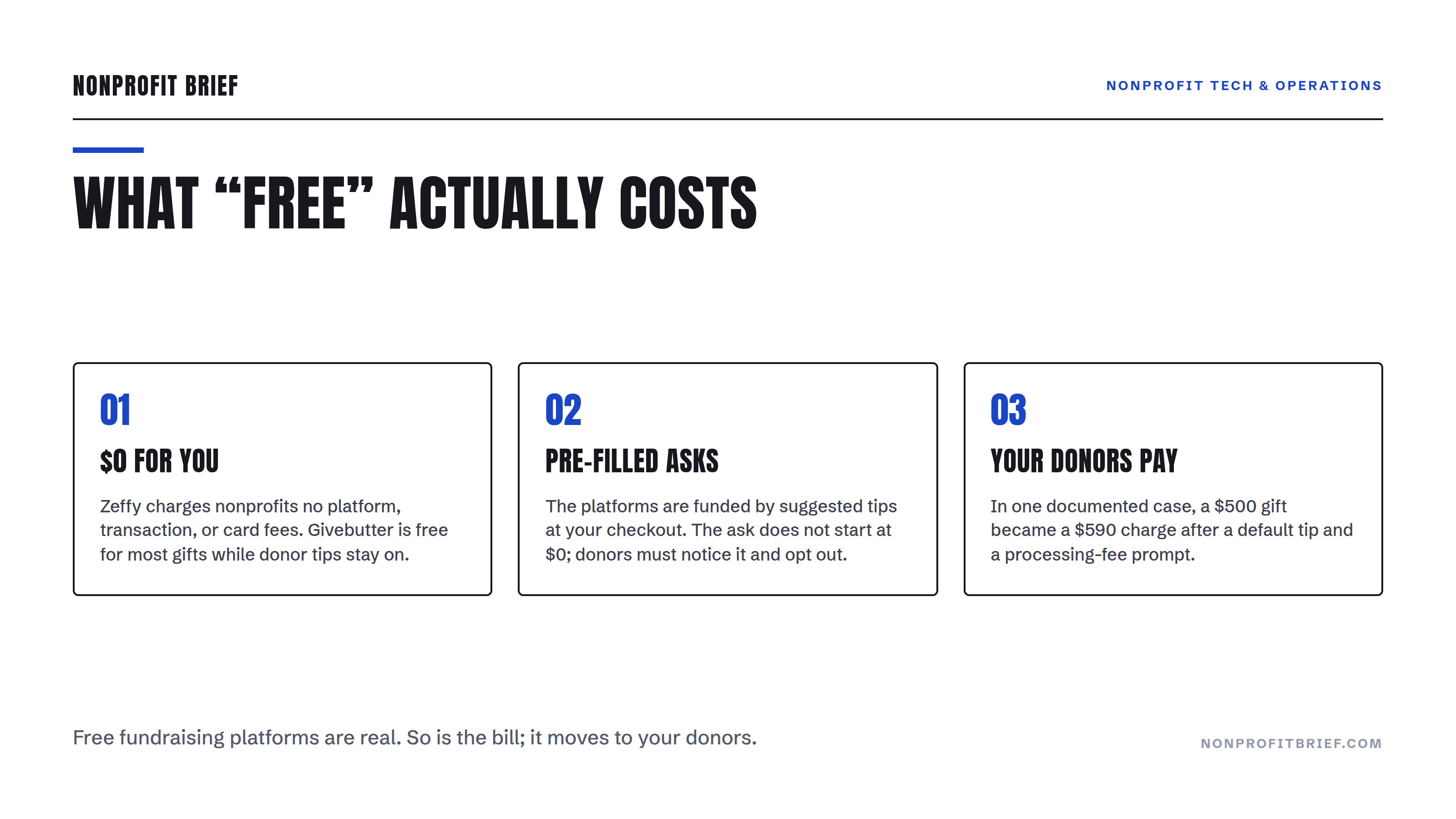
Zeffy will run your donation forms, ticketing, and raffles without charging your nonprofit a cent. Givebutter drops its fees to zero as long as donor tips stay on. GoFundMe gave up platform fees on donations years ago. None of these companies is running a charity for charities. The money that keeps them alive comes from the same place your donations do: your donors, at your checkout. The search phrase people keep typing is "is Zeffy really free," and the honest answer is yes, for you. The full answer takes a little longer.
The Zero on Your Invoice Is Real
Start with what is true in the free platforms' favor, because it is substantial. Zeffy charges nonprofits no platform fee, no transaction fee, and no card processing fee. Its pricing page says organizations keep 100 percent of what they raise, and the claim holds up: the company covers processing out of its own pocket. This is not a small operation. A Stripe case study reports Zeffy has passed $1 billion in donations processed for roughly 50,000 nonprofits.
Givebutter works differently. On the standard pricing it applies to accounts created since September 9, 2025 (older accounts stay on legacy terms until they switch), the platform costs you nothing while donor tips are enabled, with a few carve-outs: gifts through DAFpay, card readers and terminals, and recurring plans that predate the change can still carry processing fees. Turn tips off and the meter starts: a flat 3 percent platform fee plus processing of 2.9 percent and 30 cents per card transaction, or 1.9 percent and 30 cents for ACH bank transfers. ACH, the direct bank-to-bank rail, is the cheap way to move large gifts on almost every platform.
GoFundMe charges no platform fee either, but it does charge processing: 2.2 percent plus 30 cents per donation on standard GoFundMe fundraisers for certified nonprofits in the U.S. (its GoFundMe Pro product is priced separately). That number is worth remembering, because it is a fair benchmark for what a conventional, non-free stack costs in processing alone.
Now the math. Say your organization raises $50,000 online this year across 400 gifts. On a conventional processor at 2.2 percent plus 30 cents, you would give up about $1,220. At the more common 2.9 percent plus 30 cents, about $1,570. On Zeffy, or on Givebutter with tips on, you give up $0. For a small organization, $1,200 to $1,600 is a program line, and the free platforms genuinely hand it back. That is the case for them, and it is a real case.
The Platform's Paycheck Moves to Your Checkout
Here is the other half. A platform that charges you nothing has to get paid somewhere, and both Zeffy and Givebutter get paid inside your donation flow, through a pre-filled ask that your donor has to notice and act on to decline.
Zeffy calls it a voluntary contribution. It appears as a separate line at checkout, and a donor can set it to $0 using a dropdown before paying. It does not start at $0. Nonprofits on Zeffy's own feedback board report pre-filled suggestions in the 15 to 34 percent range and have asked, so far unsuccessfully, for a $0 default; Zeffy's answer was clearer checkout wording with an explicit "optional" label and a self-serve refund for donors who contribute by mistake, not a lower default. Zeffy says about two in three donors leave a contribution, which is how it covers costs. Note the title of the company's own help article on the subject: "Why was I charged extra?" Donors ask.
Givebutter's version drew a public callout. A June 2026 review by the ad watchdog Truth in Advertising found the platform pre-filling a 15 percent default tip; in the example it documented, a $500 gift became a $590 charge once the tip and a processing-fee prompt were counted. A donor class action filed this spring, covered in our look at the Givebutter lawsuit, alleges a $20 donation turned into a $23.91 charge with the exits buried in fine print. Those are allegations, not findings, and Givebutter has not been found liable for anything. But the underlying arithmetic is not in dispute: when tips are on, your donors are paying the platform's bill, at rates that can exceed what you would have paid a processor.
Run the donor-side version of the earlier scenario. Your board member sends a $500 gift through your page. On a paid stack, she pays $500 and you net roughly $485 after processing. On a free platform with a pre-filled tip and a fee prompt she does not notice, she pays about $590, you receive $500, and the platform keeps the difference. You saved $15 in fees. She spent $90 more. "Free" did not make the cost disappear; it moved the cost to the person least able to see it coming.
Costs That Never Show Up on an Invoice
The tip box is the visible cost. Three quieter ones deserve a line each in your decision.
First, your checkout is part of your brand. When a donor feels tricked by a pre-filled line they did not want, the complaint email comes to you, not the platform, and the goodwill damage lands on your renewal rates. The complaints on Zeffy's feedback board come from nonprofits saying exactly this about their own donors.
Second, the business model is the product. Both companies are betting that voluntary contributions keep covering costs at scale. If donors tip less over time, the pressure lands on defaults, placement, and wording at your checkout, because that is the only revenue lever these platforms have. You are not just choosing today's checkout; you are choosing whoever wins that tension later.
Third, free has a ceiling. Givebutter sells a paid tier, Givebutter Plus, from $29 to $129 per month depending on contact count, for deeper CRM, email, and texting features, which tells you where the free feature set ends. If you are outgrowing spreadsheets, weigh the free platforms against the paid field in our small-nonprofit CRM comparison before you commit your donor data anywhere. And whatever platform sends your acknowledgments, the substantiation rules are yours to meet, not theirs; our guide to donation receipts in 2026 covers what a compliant receipt must say.
How to Decide, in Four Steps
One: size the actual savings. Multiply last year's online revenue by about 2.5 percent and add 30 cents per gift. If that number is a few hundred dollars, the free platforms' pitch is smaller for you than the marketing suggests. If it is a few thousand, it is real budget.
Two: make a $5 donation to yourself on the platform you are considering, on a phone, and watch every screen. What is pre-filled? How obvious is the way out? What does the confirmation email and receipt say? If you run recurring gifts, test one of those too, and check whether any tip or fee prompt repeats on later installments. Judge what your donor will actually see, not the pricing page.
Three: decide the tip question on purpose. On Givebutter you can turn tips off, and the price of that cleaner checkout is the 3 percent platform fee plus processing: about $3,070 on our $50,000 scenario, which is roughly double what a conventional processor would have charged. On Zeffy the contribution ask is not something you can remove, so the decision is whether you are comfortable with it, not how to configure it. Either way, say something. A one-line heads-up on your donation page telling donors the platform's ask is optional costs you nothing and buys back trust.
Four: route the edge cases around the checkout. A $5,000 card gift with a 15 percent pre-filled suggestion is a $750 surprise waiting for a donor who clicks fast. For major gifts, offer ACH or a check and keep the card form for everyday giving. Zeffy's own help center says that in rare cases of heavy card volume with few donor contributions it may cap card payments temporarily while leaving ACH open, one more reason large gifts belong on the bank rail. For event tickets, remember buyers expect retail checkout norms, and a tip ask reads differently at a gala than under a $25 donation.
The takeaway
Zeffy really is free for your nonprofit, and Givebutter really is free for most gifts while tips are on. The savings are real, material for small organizations, and honestly delivered. The cost is also real: it is paid by your donors, through pre-filled asks at your checkout, sometimes at rates above what you would have paid a processor yourself. Take the free platform when the math says so, but take it with your eyes open, test your own donation flow before your donors do, and recheck it once a year. Nothing about "free" removes the cost. It only decides who pays, and whether they see it.