The pitch sounds like the answer to everything: a grant writer who charges nothing up front and takes 10 percent of whatever they win. No risk, no cash out the door, you only pay for results. For a small nonprofit with no development staff, it feels like the one hiring decision that cannot go wrong. It is actually the one arrangement the entire grant profession has agreed to prohibit, and the reasons are practical, not precious. Here is why commission-based grant writing fails, what it can cost you with funders, and what a fair deal actually looks like.
The Professional Codes Are Not Ambiguous
Both major professional bodies ban the arrangement outright. The Grant Professionals Association's code of ethics says members "shall not accept or pay a finder's fee, commission, or percentage compensation based on grants" and directs them to discourage organizations from making such payments. The Association of Fundraising Professionals' ethical standards require members to decline "finder's fees, commissions, or compensation based on a percentage of funds raised." These are not obscure clauses. They are the reason a credentialed grant professional will walk away from your commission offer, which means the writers who accept it are selecting themselves out of the profession's mainstream.
Note what the codes do allow. The GPA code permits performance-based bonuses, provided they follow the organization's normal compensation practices and are not calculated as a percentage of grant money. A year-end bonus for a strong season is fine. A cut of the award is not. The line is the percentage, not the idea of rewarding good work.
The Money Problem: You Cannot Pay It From the Grant
Set ethics aside for a moment and follow the dollars. Suppose a writer lands you a $50,000 program grant and their agreement says 10 percent. Where does the $5,000 come from?
Not from the grant. A grant is awarded for the budget you proposed: staff, supplies, program costs. Writing the proposal happened before the award existed, and while federal agencies can approve certain pre-award costs in writing, proposal writing is not what that path covers. Federal rules treat it separately: under 2 CFR 200.460, proposal preparation costs are normally treated as indirect costs spread across the organization's activities, not charged to the award they produced. Private foundations take the same view informally, and the GPA code adds that compensation should not be written into grants unless the funder allows it.
So the commission comes out of your unrestricted money, the scarcest dollars you have. If the $50,000 award is restricted to the program, and most program grants are, you now owe $5,000 of unrestricted cash you may not have. We walked through why that distinction bites in restricted versus unrestricted funds. A commission deal converts your least flexible revenue into a bill against your most flexible revenue. That is the trade going the wrong direction.
Funders Notice, and Some Will Walk
Grant budgets get read closely. A reviewer who spots a percentage fee, or hears about one, learns two things: part of their grant is not going to the mission as proposed, and your organization signed an arrangement both professional codes bar their members from entering. The Puget Sound Grantwriters Association puts the funder view plainly: grantmakers frown on contingency fees, and many will not fund an organization they learn pays consultants this way. One foundation officer they quote warns that if commission pay became standard practice, public confidence in nonprofits would suffer. You will rarely get a rejection letter that says "commission clause." You will just lose ground with the funders most attentive to stewardship, who are also the funders you most want.
The Incentives Are Bad for You, Not Just the Writer
Commission deals are usually framed as risky for the writer, who might work unpaid. The subtler problem is what the incentive does to the work you receive.
A commissioned writer earns nothing on a declined proposal, so the rational move is volume: many applications, minimal customization, aimed at the largest awards available. That is the opposite of how grants are won. Winning depends mostly on fit between your program and the funder's priorities, your track record, and relationships, none of which the writer controls and none of which improve with volume. We covered what actually drives the odds in how to find grants and in reading an RFP like a reviewer. A commissioned writer also has no reason to tell you the honest thing a salaried or flat-fee writer will: that you are not ready for this funder, or that the RFP is a bad fit and the hours are better spent elsewhere. The advice you most need is the advice their pay structure punishes.
Run the writer's side of the math and the volume problem gets concrete. Ten percent of a $2,500 small-town grant that took 10 hours to research and write is $250, thin pay for skilled work if it wins and nothing at all if it does not. Ten percent of a $50,000 proposal that took the same 10 hours is $5,000. Every incentive points the writer toward big-ticket applications regardless of your actual odds, and toward dropping you the moment a larger client appears.
What Fair Pricing Looks Like
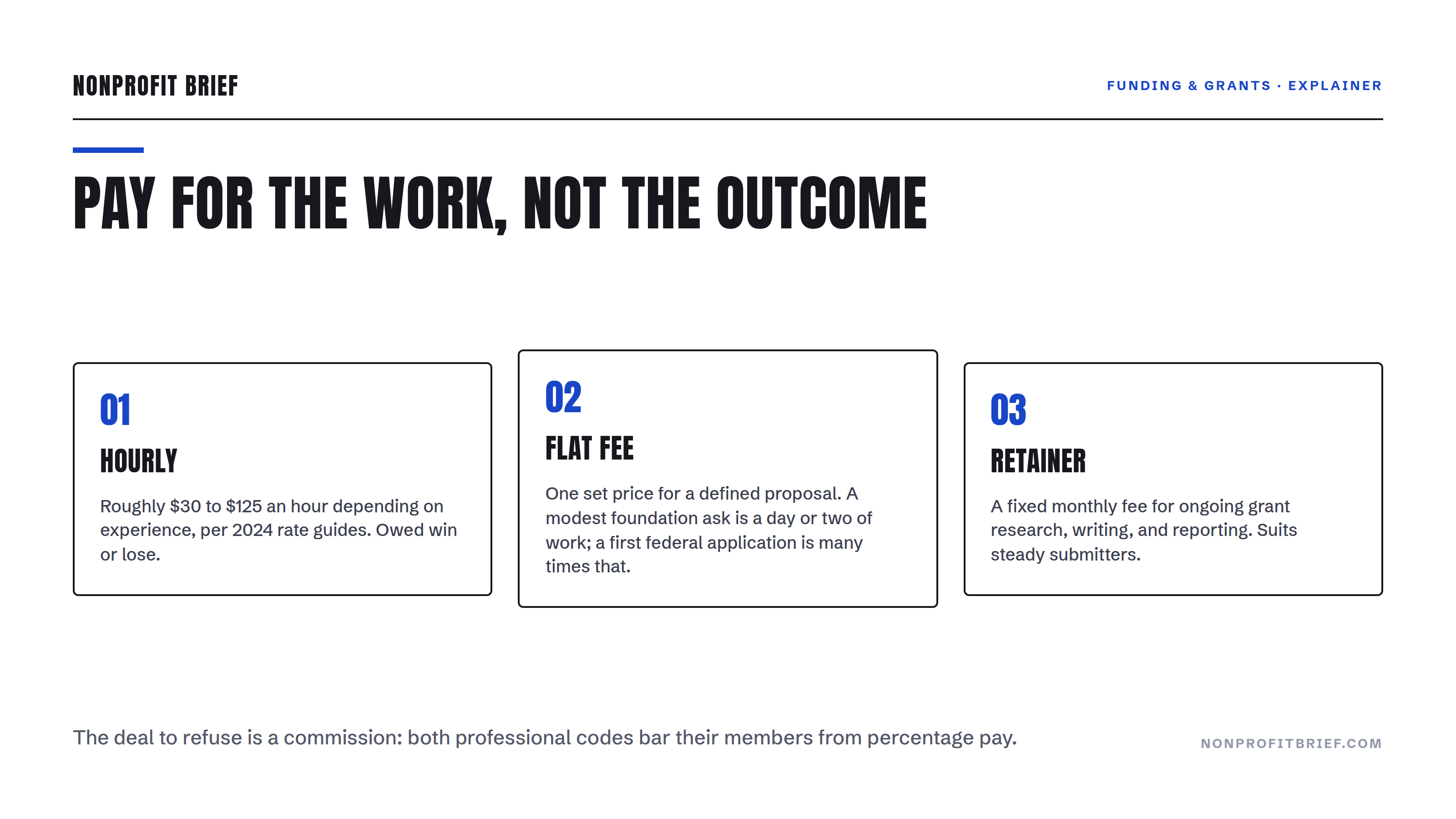
Legitimate grant writers price the work, not the outcome, in one of three shapes.
Hourly is the most common for project work. Published rate guides, such as Instrumentl's 2024 rate guide, put contractors roughly between $30 and $125 an hour depending on experience, with the most experienced writers at the top of that range and sometimes above it. Flat per-proposal fees price the same hours as a package: a modest foundation proposal is a day or two of work, a first-time federal application is many times that, and the quote should tell you which you are buying. Retainers, a fixed monthly fee for ongoing research, writing, and reporting, suit organizations submitting steadily rather than once.
Whichever shape, a fair agreement has the same skeleton: a defined scope, a rate set before work begins, payment owed whether or not the grant is awarded, and deliverables you keep either way, including the boilerplate, budgets, and case language you can reuse in the next application. That last part matters more than it looks. A well-built proposal file is an asset that outlives the decision, which is part of what you are paying for.
One variation to treat carefully: deferred payment, where a writer offers to invoice after the funder decides. If the invoice is owed regardless of outcome, that is a payment plan and it is fine. If it is owed only on a win, it is a commission wearing a different name, and every problem above still applies.
If You Cannot Afford a Writer Up Front
The honest answer to "we can only pay from winnings" is usually that grants are the wrong next move, not that commission is the right deal. A new organization with no cash for a modest proposal fee will also struggle with what comes after a win: delivering the program, fronting costs on a reimbursement grant, and reporting. We made the fuller argument in our honest answer on grants for new nonprofits: build a small base of individual and board giving first, then buy grant help with real money and a defined scope.
If you are close but not there, scale the purchase down instead of converting it to commission. A few hours of a professional's time to review a draft you wrote costs a fraction of full proposal development. So does a one-time engagement to build your boilerplate file, which makes every later application cheaper, whoever writes it.
The Takeaway
Commission-based grant writing is prohibited by both professional codes, unwelcome to funders, and structurally bad for the nonprofit that signs it: the fee cannot come from the grant, so it lands on your unrestricted cash, and the incentive pushes your writer toward volume over fit. Pay for grant writing the way you pay for bookkeeping, as skilled work at a set price, hourly, flat, or on retainer, owed win or lose. And if the only version you can afford is a percentage of winnings, take that as the useful signal it is: the next dollar of fundraising effort belongs with donors, not applications.