RKD Group released its 2026 Mid-Year Benchmark Report this week, and the topline looks like good news: $1.86 billion in first-half revenue across the 219 nonprofits in the dataset, a 10-year high. The rest of the report explains why almost nobody who raised that money feels like they are having a record year.
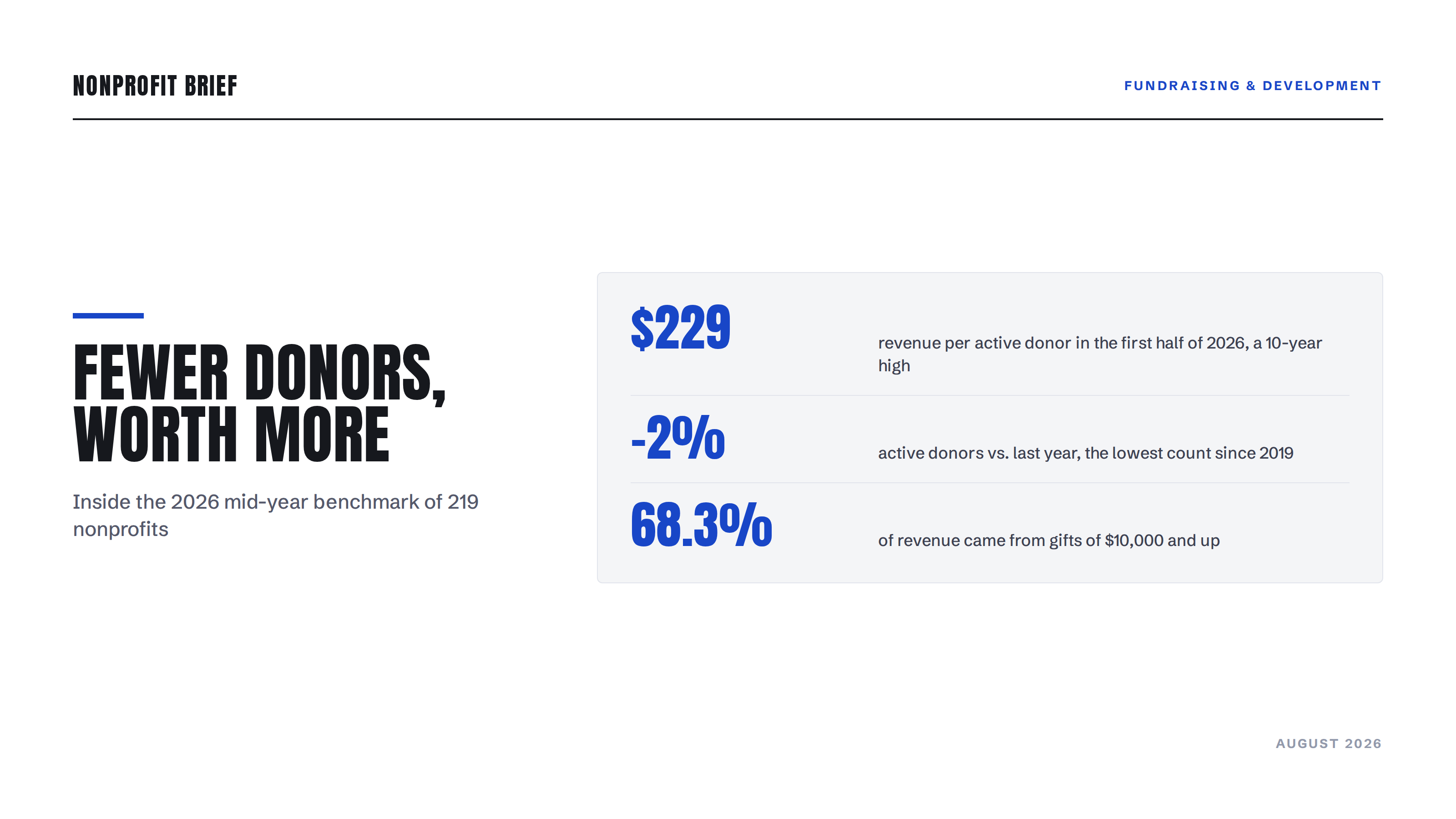
The high is a nominal one. Revenue is up 51% over 2017 before inflation; adjust for it, and the first half came in 3.0% below 2021. The donor file tells the harder story. Active donors fell to 2,585,127, down 2% from last year, 22.2% below the 2020 peak, and the lowest count since 2019, The NonProfit Times reported. New and reactivated donors declined for the fifth consecutive year, by RKD's own accounting.
Revenue Per Donor Is at a 10-Year High
The organizations in this dataset raised more from fewer people. The report puts revenue per active donor at $229 for the first half, up 27.2% from 2021 in nominal terms, still up 3.6% after inflation, and the highest figure in its 10 years of data. Gift frequency set a record too. So did mid-level giving, meaning donors in the $1,000 to $10,000 range, and monthly giving, which hit $114.9 million, up 29.9% from 2021 before inflation and 1.8% after it, one of the few lines in the report that clears that bar at all.
Above that band, concentration continues. Gifts of $10,000 and up accounted for 68.3% of total revenue, while revenue from gifts under $10,000 is down 16.9% from 2017, with the average gift down 13% over the same stretch. Put plainly: the base is shrinking, the middle and the majors are carrying the growth, and the donors who stay are worth more each year than the ones they replace.
Whose Data This Is, and Why That Matters
RKD Group is a direct-response fundraising agency, and the benchmark is built from its client base: 219 organizations in animal welfare, food banking, health, hospitals, and humanitarian and rescue mission work in the U.S. and Canada. That is a real sample with 10 years of history behind it, but it is an agency's client file, not a census, and direct-response programs are exactly where small-gift erosion shows up first.
The direction still matches the sector-wide sources. Giving USA counted a record dollar year for 2025, and the Fundraising Effectiveness Project's data has shown the same shape for years: dollars up, donors down. This report adds a mid-2026 data point and a sharper read on where the remaining growth lives.
What This Asks of Your Year-End Plan
If your file looks anything like this benchmark, three moves matter more than a bigger acquisition budget.
First, protect retention before you chase anyone new. When each active donor brought in $229 in six months, losing one costs more than it did five years ago, and the retention math compounds from there. A thank-you cadence and a second-gift program are cheaper than any acquisition channel.
Second, build a path to the middle. Mid-level giving is setting records because organizations finally treat $1,000-to-$10,000 donors as a distinct audience rather than direct mail names with bigger averages. Pull the list of donors who gave $250 to $999 in the past 18 months and decide, by name, what the upgrade ask looks like in your year-end sequence.
Third, put a monthly ask in front of one-time donors. Monthly giving is one of the only lines in this dataset still growing after inflation, and it is the revenue that keeps paying after December. Your year-end series should include at least one touch where the primary ask is a sustainer conversion, not a larger single gift. Before any of that, make sure the file itself is clean enough to segment; a year-end data cleanup is the unglamorous first step.
The Takeaway
The mid-year numbers describe a sector that has quietly traded breadth for depth. Fewer people are giving, the ones who remain give more, and the growth is concentrated in mid-level and monthly donors rather than the broad base. You cannot fix the national trend from your desk. You can decide that your year-end plan treats retention, mid-level upgrades, and sustainer conversion as the main event rather than the garnish, because in the data we now have for 2026, they are.