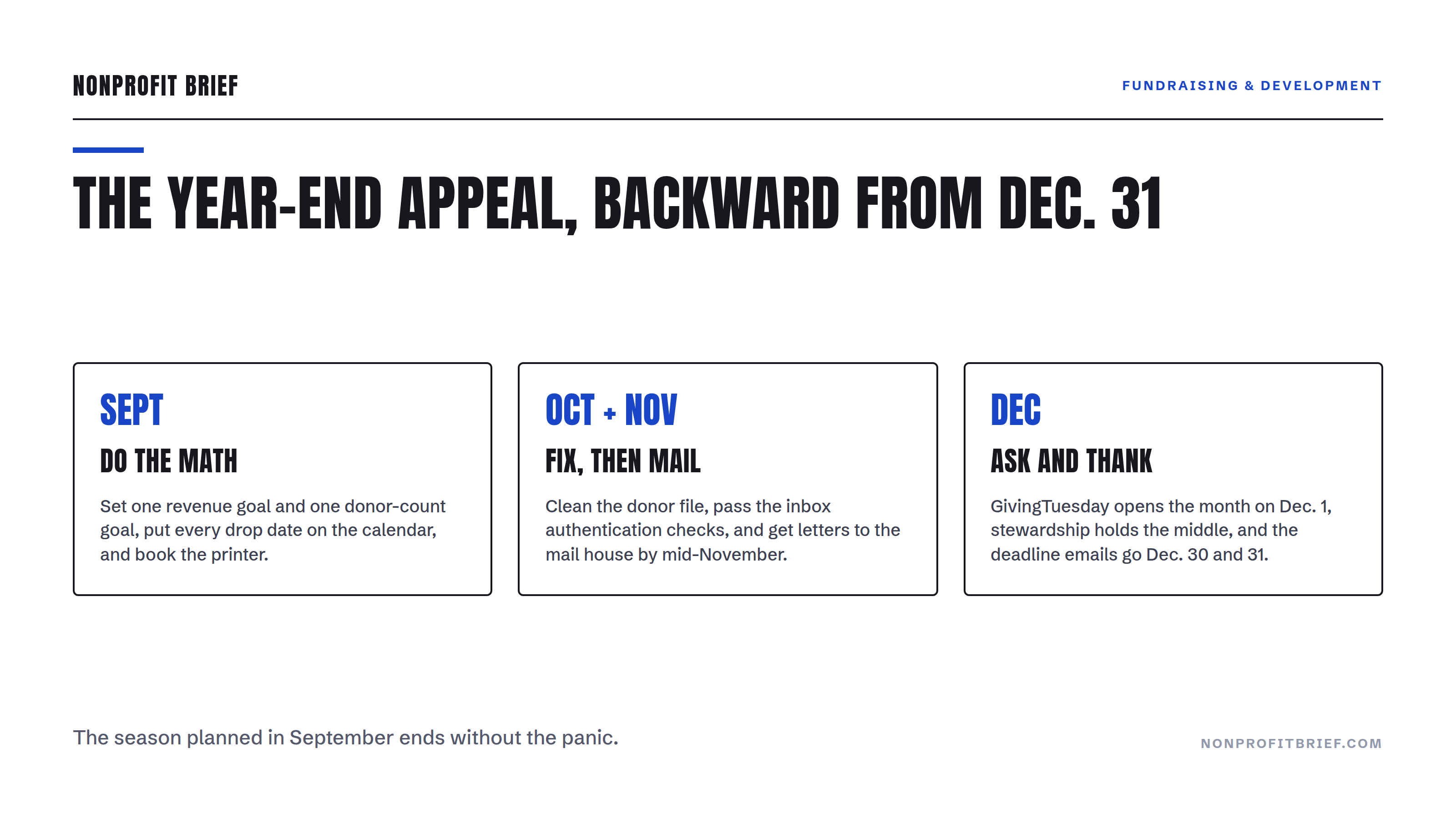
The year-end appeal is the one fundraising project whose deadline never moves. December 31 falls on a Thursday this year, GivingTuesday lands on December 1, and everything else in your fall works backward from those two dates. What follows is the working calendar, built from the deadline back to this week, sized for a small shop where the executive director is also the development department.
One honest note before the schedule. December matters, but it is not the whole year. Research that Neon One published with Giving USA puts December at 17 to 22 percent of annual giving, well below the "nearly a third" figure that older, online-only studies made famous. Plan for a strong December. Do not plan for December to rescue a weak year, because the retention math says the donors you kept warm from January through November are what December is built on.
December 29 to 31: The Deadline Days
A gift has to count as made in 2026 to be deductible for 2026. A mailed check counts on the date it is mailed, with the postmark as the evidence, under what practitioners call the mailbox rule, and a credit card gift counts in the year the charge is made, even if the donor pays the bill in January, per IRS Publication 526. Your final two emails, one on the morning of December 30 and one on the morning of December 31, should say this plainly and link straight to your donation page.
You also have a genuinely new talking point this year. Starting with tax year 2026, donors who do not itemize can deduct up to $1,000 in cash gifts, or $2,000 on a joint return, per IRS Topic 506. The deduction covers cash gifts to qualifying public charities; it does not cover gifts routed to donor-advised funds or supporting organizations, and itemizers now face a new floor of 0.5 percent of adjusted gross income on their own deduction. Our full breakdown of the 2026 rules has the detail. The practical point for your appeal: this is the first year-end since 2021 when the donor who takes the standard deduction gets a federal deduction for the gift you are asking for. State it as a fact in your copy, and steer clear of promising anyone a tax outcome, because their result turns on their own return and this is not tax advice for any one donor.
Hold the last two days for execution only. No new segments, no new creative, just sends, gift processing, and same-week thank-yous.
December 1 to 28: One Kickoff, a Quiet Middle, and a Countdown
GivingTuesday is December 1 this year, and it is not a niche event: the movement's own tally put U.S. giving at $4.0 billion on GivingTuesday 2025, up 13 percent from the year before. Whether you run a full campaign or a single email is a September decision, not a November scramble; either way, the day works best as the opening of your season, not the whole of it.
The middle two weeks of December are quieter on purpose. Your print appeal is arriving in mailboxes, replies are trickling in, and the job is stewardship: process gifts fast, send receipts that hold up, and call or hand-write notes to your larger donors. Every acknowledgment for a gift of $250 or more needs the gift amount and the goods-or-services statement, and it has to reach the donor before they file their return, or the deduction is gone no matter how the receipt reads; our receipts guide has the exact language and timing rules. The countdown series then runs December 29 to 31.
November: Warm the House Before You Ask
Thanksgiving is November 26, and the week before it is for gratitude, not asks: an impact email, a board thank-a-thon, a short update to monthly donors. It reads better in November and it lifts response in December.
November is also when the print appeal leaves your hands. Letters should be at the mail house or post office by mid-November to clear holiday mail volume, and postage is a real budget line since this year's rate increase. Segment before you print. The mid-year benchmark data showed mid-level and monthly donors carrying 2026 giving, so your best-performing letter is the one that treats those two groups differently from the cold file: a personal note and a bigger ask for mid-level donors, and an upgrade or second-gift ask, not a generic appeal, for sustainers.
October: Fix the Plumbing
October is infrastructure month, and none of it is glamorous. Clean the file first, because segmentation built on stale records mails the wrong ask to the wrong person; the year-end data cleanup is a two-afternoon job if you scope it tightly. Check that your sending domain passes the email authentication rules the big inbox providers now enforce, because December email revenue is zero if the emails land in spam. Then lock the appeal copy, book the printer, and draft the receipt template so late December is execution, not invention.
September: Do the Math, Then Book Everything
This week's work fits on one page. Pull last year's year-end numbers: total raised, gifts by segment, and what each channel returned. Set one revenue goal and one donor-count goal. Decide the GivingTuesday question now. Put every drop date above on the actual calendar, working backward from December 31, and get the board to agree in September to the calls and notes you will ask of them in December. A year-end season planned in September is a season where the only December surprise is the response rate.
The Takeaway
The deadline does the planning for you if you let it. Two emails in the last three days, a quiet stewardship stretch behind a mailed appeal, a gratitude week before Thanksgiving, an infrastructure October, and a one-page plan this month. The new non-itemizer deduction gives your copy a fact it has not had in five years, and the calendar takes the late-December panic off the schedule. Work backward from December 31, and start this week.