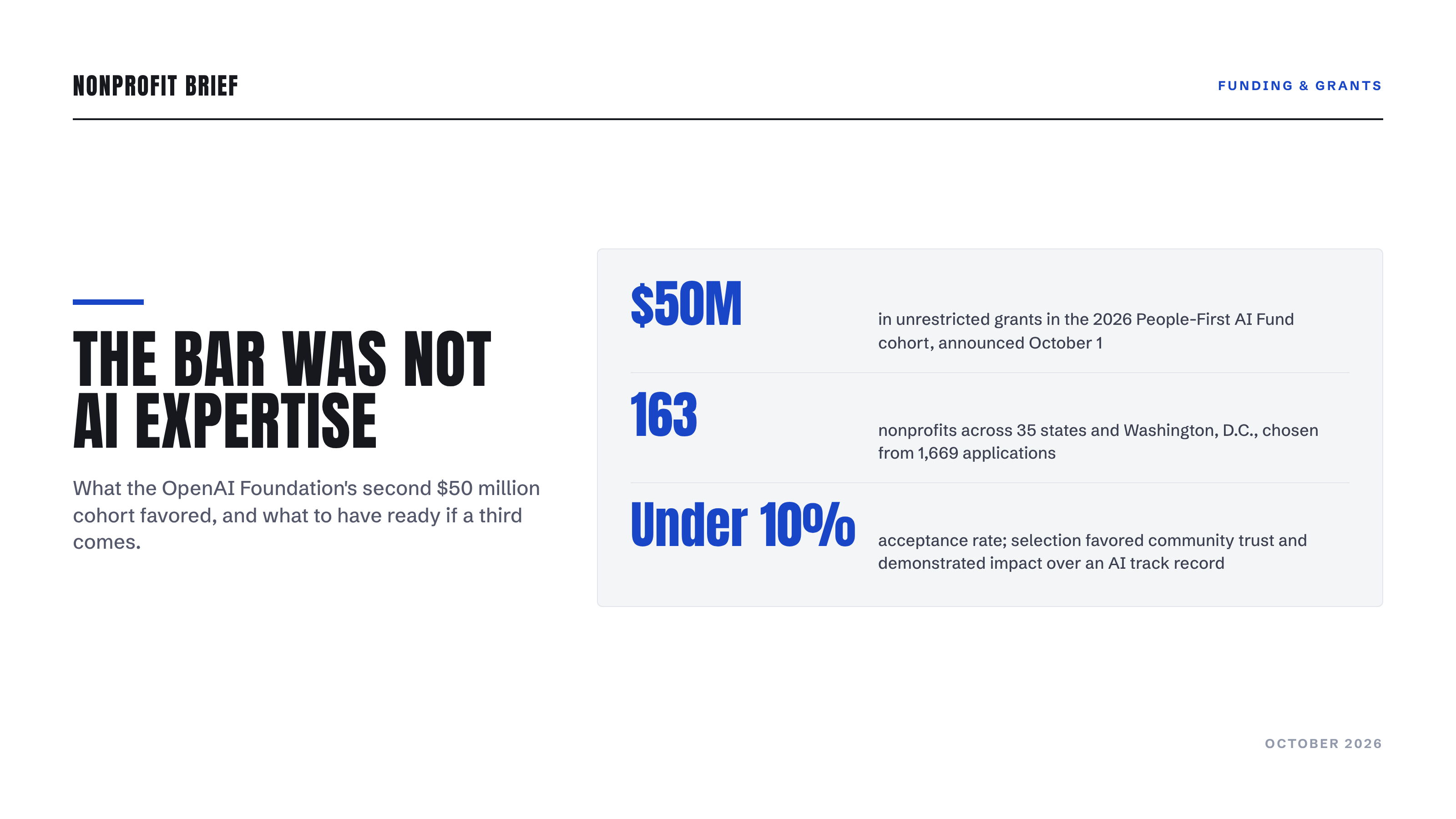
The OpenAI Foundation on October 1 named the 163 nonprofits that will share its 2026 People-First AI Fund. The fund totals $50 million. The grants are unrestricted, and the foundation says it aims to disburse every grant in full before the end of 2026. That works out to an average of roughly $300,000 per organization, though individual awards were capped at 10 percent of each grantee's budget, so the actual checks scale with organizational size. Either way, it is money with no program strings attached, from a funder that did not exist two years ago.
Even if you did not apply, the announcement is worth ten minutes. It is the clearest picture yet of how AI-industry money behaves when it reaches community philanthropy: fast, unrestricted, and aimed at organizations that look nothing like tech nonprofits.
The Bar Was Not AI Expertise
The 2026 round drew 1,669 applications in a one-month window this summer, which puts the acceptance rate just under 10 percent. Selection, per the foundation, emphasized community trust, demonstrated impact, and a thoughtful approach to exploring AI. Notice what is missing from that list: an AI track record. The June open call said organizations did not need prior AI experience, and the grants are tool-agnostic. Grantees keep, in the foundation's words, full autonomy to choose, or not, any tool or platform.
The winners' list reads accordingly. It includes legal aid (Greater Bakersfield Legal Assistance in California), tenant-rights tools (JustFix in New York), community arts (Nashville Jazz Workshop in Tennessee), and nonprofit newsrooms (Honolulu Civil Beat in Hawaii). The 163 organizations span 35 states and Washington, D.C.
How the Round Worked, for Your Files
The structure is worth recording in case it runs again. The 2026 application window ran from June 15 to July 15. Eligibility was scoped to mid-sized, standalone community organizations: independent U.S. 501(c)(3) public charities operating primarily in the 50 states or D.C., with annual budgets between $500,000 and $10 million and priority given to the $1 million to $8 million range. Programs housed inside larger institutions did not qualify, and neither did fiscally sponsored projects, even ones with their own budgets in range. Community foundations and other regranters had a separate track with a budget ceiling of $15 million, excluding pass-through grantmaking. Grants were capped at 10 percent of annual budget, one application per organization, one-time awards, with what the foundation described as light-touch reporting. Three focus areas defined the round: community support services such as legal aid and benefits navigation, community arts and cultural organizations, and community journalism.
Review happened outside the company. The foundation says external grantmakers evaluated every application, in a process developed by Daniel Zingale, who convened OpenAI's Nonprofit Commission, working with a set of outside advisors.
Two Cycles In, This Is a $100 Million Pattern
The fund launched in September 2025 with an initial $50 million and nearly 3,000 applications. That first cycle went out as $40.5 million to 208 organizations in December 2025, plus a further $9.5 million in June 2026 that leaned toward health and local journalism. The cohort announced this week is the second $50 million cycle, and its focus areas shifted from the first round's AI literacy, community innovation, and workforce themes toward direct community services. The 2026 call also said the foundation anticipated primarily funding new organizations, so 2025 grantees were eligible but not favored, a pattern worth noting if a third cycle comes and you have already won once.
Two oversubscribed cycles in two years looks like a standing program. It is not one yet. The foundation has not announced a 2027 round, and nothing in this week's announcement promises one. What you can reasonably expect is the calendar it has used twice: a roughly one-month application window, opening in early summer or fall, with most of the money out the door within months of selection.
The sensible preparation costs nothing. If your budget sits between $500,000 and $10 million and your work touches the three focus areas, put a quarterly reminder on the development calendar to check the foundation's news page starting in late spring. Draft the two things every fast open call asks for: a plain-language case for why your community trusts you, and an honest paragraph on how you would explore AI, which can borrow from the governance questions in our piece on nonprofit AI rules lagging use. Then treat it like any other prospect in your pipeline, subject to the same research discipline as any funder you pursue.
The Takeaway
AI-industry philanthropy is no longer hypothetical money. Between this fund's $100 million over two cycles and the Gates Foundation's $1 billion AI commitment, the sector's newest funders are writing real checks, and this one writes them unrestricted, to ordinary community organizations, selected for trust rather than technical fluency. If that is your profile, the cost of being ready for a third cycle is an afternoon. The cost of assuming there will be one is zero, as long as you spend nothing but the afternoon.