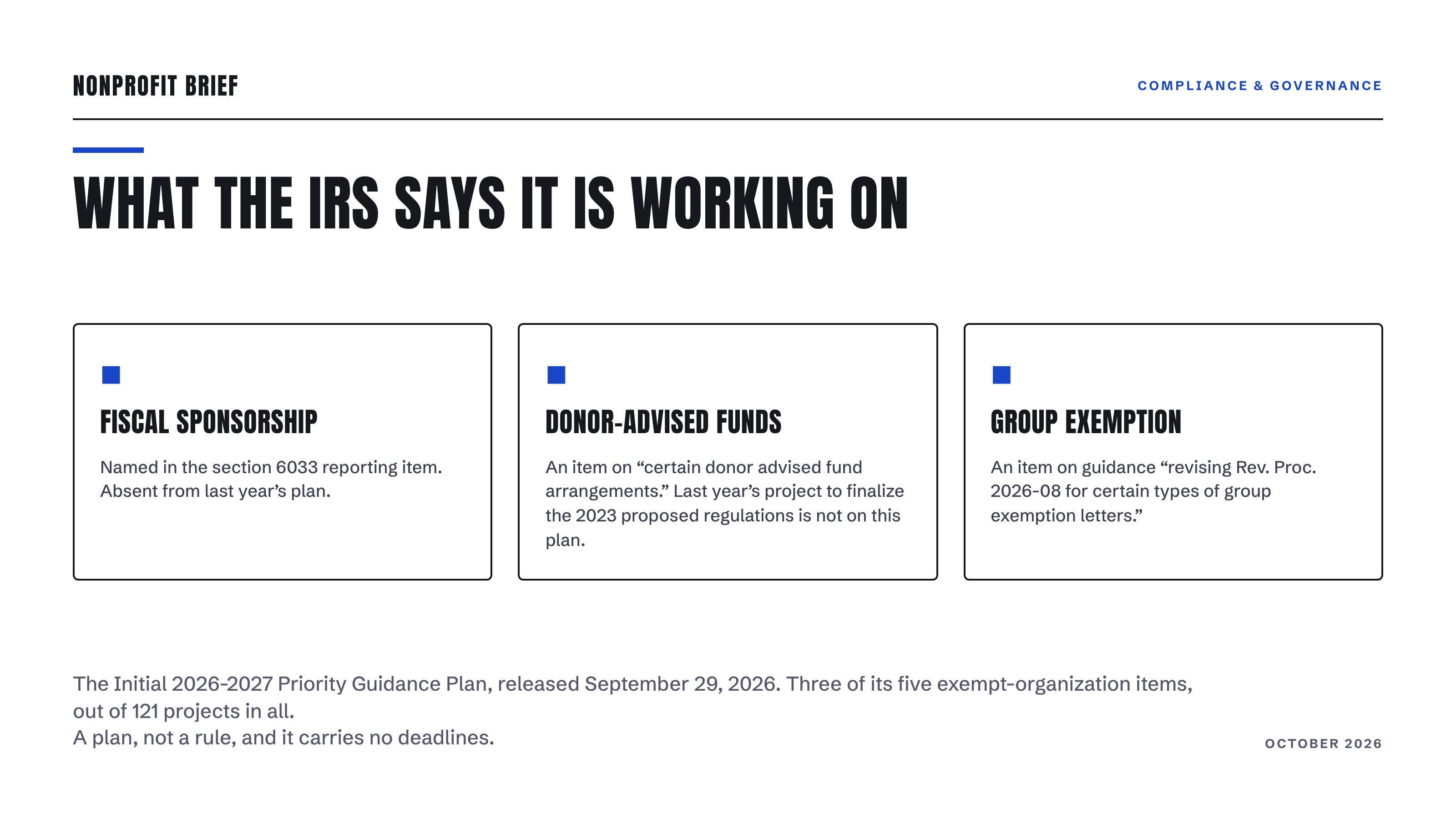
Fiscal sponsorship has run for decades on practice, Rev. Rul. 68-489, and private letter rulings that cannot be cited as precedent. No published guidance addresses it as such. On September 29 Treasury and the IRS put it on their 2026-2027 Priority Guidance Plan, in the item on exempt organization information reporting: "including with regard to fiscal sponsorship arrangements."
That is the newest thing on a list of five exempt-organization projects, and on our read the one most likely to change how a whole category of organizations reports its money. It is also the entry most readers will skim past.
A Plan Is Not a Rule
The Priority Guidance Plan is the annual list of what Treasury and the IRS intend to work on, 121 projects this year. Its own framing is modest: the projects "will be the focus of our efforts during the plan year," and the plan "does not provide any deadline for completing the projects." Items sit on these lists for years and produce nothing. The 2023 proposed donor-advised fund regulations were never finalized, and the project to finalize them, carried on last year's plan, has now dropped off entirely.
The Five Exempt-Organization Projects
Private school eligibility. Final regulations on applying the fundamental public policy against racial discrimination, "including consideration of recent caselaw," in determining whether a private school qualifies under 501(c)(3). Proposed regulations published September 4 would strike the sentences in Rev. Proc. 75-50 permitting race-conscious admissions, programs, and scholarships meant to promote a school's nondiscrimination policy. They reach discrimination "for any purpose," including where it "is defended as serving remedial or diversity-related objectives." Comments close November 3.
Political campaign activity. Guidance on the 501(c)(3) prohibition on participating or intervening in political campaigns, which the plan itself calls the "Johnson Amendment." This is a word-for-word carryover from last year's plan, so its presence is not news. What matters is what it would guide. The prohibition is absolute, in the statute and in Treas. Reg. 1.501(c)(3)-1, with no de minimis exception; the facts-and-circumstances analysis goes to whether an activity counts as intervention, not to how much is allowed. Until guidance issues, the existing election-year rules bind you.
Group exemption letters. Guidance "revising Rev. Proc. 2026-08 for certain types of group exemption letters." January's group exemption overhaul superseded Rev. Proc. 80-27, letting the IRS resume accepting group exemption applications after a pause since 2020. A revision item arriving this fast suggests parts of it need work, though the "certain types" qualifier cuts against reading that broadly. Relevant if you are a central organization or a subordinate.
Donor-advised funds. Guidance under sections 4966 and 6033 on "certain donor advised fund arrangements." Note what it replaced. Last year's plan carried a project to finalize the November 2023 proposed DAF regulations on excise taxes for sponsoring organizations and fund management. That project is gone, and this narrower item sits in its place. For a grantee, the thing to know about 4966 is who pays: the excise tax on a taxable distribution falls on the sponsoring organization, not the donor and not you, and grants to ordinary public charities are already excepted. Section 6033(k) already requires sponsors to report fund counts, asset values, contributions, and grants. If you rely on DAF revenue, follow it, though the narrowing reads to us as the real signal.
Information reporting, including fiscal sponsorship. Guidance under section 6033 on exempt organization information reporting, named as including fiscal sponsorship arrangements. Section 6033 is the annual return requirement, with mandatory exceptions for churches and their integrated auxiliaries and for certain publicly supported and religious organizations whose gross receipts are normally not more than $5,000, and subsection (j), which drives automatic revocation after three years of non-filing. Last year's plan did not use the words "fiscal sponsor" anywhere. What this item produces is unknown; that it is being worked on is not. If you sponsor projects or are one, fiscal sponsor 990 reporting is the practice to be able to defend.
Five More Items, Filed Elsewhere
Five other projects reach nonprofits, all carryovers from last year's plan:
- Regulations under section 25F on the income tax credit for individual contributions to scholarship granting organizations, which are themselves 501(c)(3)s. It is the plan's first item.
- Regulations under section 4960 on excess compensation paid by applicable tax-exempt organizations, "including the expanded definition of 'covered employee'." We covered the covered-employee expansion.
- Regulations under section 4968 on the excise tax based on investment income of certain private colleges and universities.
- Regulations under section 4945 on expenditure responsibility. It applies when a private foundation grants outside the statute's safe list, which covers most public charities and exempt operating foundations but not certain supporting organizations, and section 4966 imposes it on DAF sponsors too. The grantor must commit funds to purpose, collect grantee reports, and report the spending to the IRS.
- Final regulations on reporting charitable contributions of trusts under section 6034, a narrow relieving change for trusts whose only charitable deduction comes through a passthrough entity. Proposed regulations published August 17, with comments closing October 16.
A sixth, under section 6104 on "the place for public inspection of materials relating to tax-exempt organizations, pensions, and other plans," reads as an IRS-side administrative item rather than a change to what you must hand the public.
What to Do With This
Nothing, on account of the plan. A project appearing on a guidance list changes no obligation, and no filing position should move on one.
The already-issued guidance on the list is different, and two pieces are live. The section 6034 comment period closes October 16, the private school one November 3. Those are the channels that count: 5 U.S.C. 553(c) makes an agency consider the comments it receives on a proposed rule, and they become part of the record on review, which informal suggestions do not. Treasury does invite recommendations year-round, worth doing for items with no proposal yet, fiscal sponsorship and DAFs among them. Do both, in that order of weight.
The second use is diagnostic. If you have run a practice on the assumption that an area is settled because nobody wrote it down, this plan names which of those assumptions the agency considers open. Fiscal sponsorship reporting is the clearest case. A sponsor or sponsored project treating current practice as permanent should raise it with counsel before guidance lands rather than after, since how it applies turns on your own arrangements and this is not legal advice for your situation.
The takeaway
Five exempt-organization projects sit on Treasury's new guidance plan: private school nondiscrimination regulations, the carried-over Johnson Amendment item, a revision to January's group exemption overhaul, a narrowed donor-advised fund item replacing the stalled 2023 regulations, and section 6033 reporting that now names fiscal sponsorship. Five more items elsewhere reach scholarship granting organizations, executive compensation, college endowments, expenditure responsibility, and trust reporting. None of it is law and none has a deadline. The only real dates are two comment periods, October 16 and November 3. The one genuinely new thing is that the agency has named fiscal sponsorship at all.