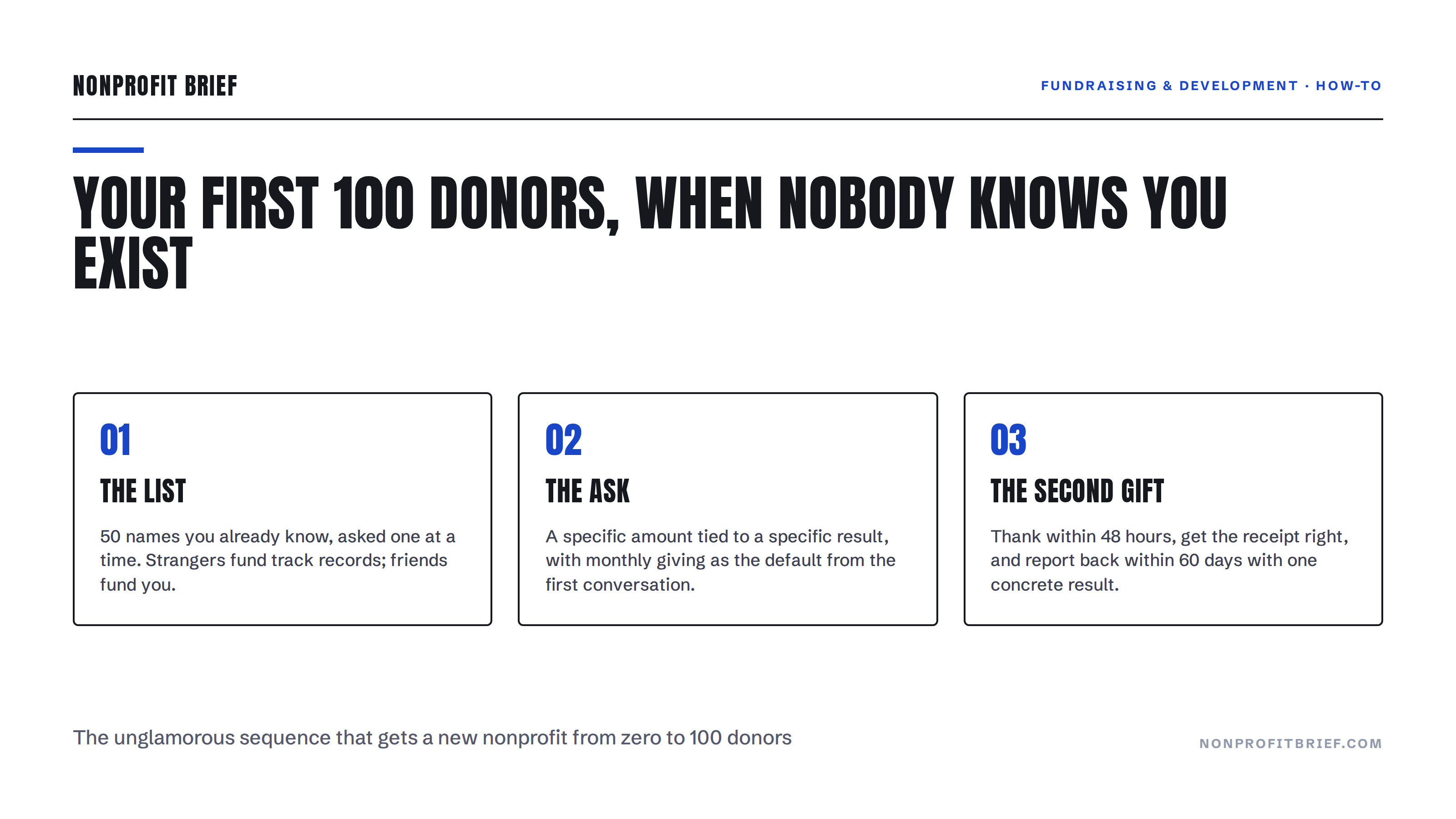
Your new nonprofit has a mission, a bank account, and a donor list with zero names on it. Nobody is searching for you. No foundation will fund you yet. The first 100 donors have to come from somewhere else: from people, asked one at a time, by you. That sounds slow because it is. It is also the only acquisition channel that works at this stage, and it builds the base every later channel depends on.
Handle the Paperwork Before the First Ask
Three things come before any ask. First, most states require charities to register before soliciting their residents, a rule that catches new founders off guard; our guide to registering to fundraise covers the mechanics, and the state charity regulators association links to each state's office. Start with your home state. Second, set up a way to take money online that does not eat your margin; we compared what free platforms cost in practice. Third, have a receipt ready to send the day the first gift lands. The template takes an hour, and our receipt guide for 2026 has the required language.
Your First Donors Give to You, Not Your Mission
Strangers fund track records. Friends fund you. So the first list is not a prospect list, it is your address book: family, friends, coworkers, former coworkers, neighbors, your board, and your board's address books. Write down 50 names before you decide who is "not a donor type." People say yes to people they know at rates no cold channel approaches, and a new organization has no other asset that compares. If listing 50 people feels impossible, that is a signal to recruit board members and early volunteers who bring networks, not a reason to buy one, and we will get to why buying one fails.
Make the Ask Specific, Small, and Personal
The ask itself is a sentence, delivered by phone, in person, or in a short individual message. Not a mass email. Name a number and name what it does: "$25 covers one student's materials for a semester, and I am trying to find 100 founding donors by March." Two things are doing work there. The concrete number with a concrete result makes the decision easy. And "founding donor" gives early supporters a story they keep telling; the first 100 are buying into you before there is proof, and the label should say so. Track every yes and every no in a spreadsheet from day one. That spreadsheet is your CRM until well past donor 100.
Ask for Monthly Money From the First Conversation
A $10 monthly gift matches a $50 one-time gift by month five and passes it in month six, and monthly donors behave differently: they stay. The sector's own numbers say repeat givers are where the money is. Repeat retained donors now contribute about 61% of all dollars raised, and their giving grew more than 7% year over year, per coverage of the Q1 2026 Fundraising Effectiveness Project report. The FEP's own release calls converting first-time donors into repeat givers, including signing up sustainers at the point of acquisition, the more urgent priority for the sector. You are building at exactly the stage where that habit is cheapest to form. Make monthly the default option on your donation page and the first option in your ask.
The Second Gift Is the Whole Game
Across the sector, donor retention ran 43.3% in 2025, per full-year FEP data. Fewer than half of donors give again, and the sector still grew dollars because larger gifts and the donors who stayed made up the difference; the retention math is lopsided enough that keeping donor 40 beats finding donor 101. Your retention program at this size is three habits. Thank within 48 hours, personally, by name. Get the receipt right: for any single gift of $250 or more (the line is per gift, so a $25 monthly donor never crosses it), the IRS's written acknowledgment rules require your organization's name, the cash amount or a description of a non-cash gift (but not its value, which is the donor's job to establish), a statement of whether you provided any goods or services in return, and a description and good-faith estimate of their value if you did; religious organizations add a statement when the benefits were entirely intangible religious ones. The donor needs it in hand by the date they file or the return's due date, whichever comes first, and while the legal burden of obtaining it sits with the donor, no donor should have to ask. One more rule is yours alone: when someone pays over $75 and gets something back, you owe them a written disclosure of the deductible portion, with penalties for skipping it. The receipt guide linked above has the full template. Then report back within 60 days with one concrete thing their money did. Not a newsletter. One result, two sentences, their name at the top.
What Not to Do With Your First Dollars
Do not buy a list. Purchased names respond terribly, and blasting them can wreck your sending reputation before you have one; the email authentication rules now decide whether bulk senders reach inboxes at all. Do not spend your first year writing grant applications instead of asking people: as we covered in grants for new nonprofits, most institutional funders want a track record and financial statements you do not have yet, and 100 individual donors are themselves the evidence funders ask for. And do not throw an event first. Events are a multiplier on a community that already exists, not a substitute for one.
The Takeaway
The first 100 donors are a manual process: register, set up payments and receipts, list 50 people you know, ask each one for a specific amount with a specific result, push monthly giving from the first conversation, thank fast, and report back with one concrete outcome. It is unglamorous and it works, and by donor 100 you will have the two things every funder and every future campaign requires: proof that people trust you with money, and the retention habits that make donor 101 cheaper than donor one.